

For years, rooftop tents have followed the same formula. Heavy fiberglass shells. Steel frames. Thick hardware. Hundreds of pounds sitting on top of your van.

While these tents work, they all share the same compromise:
Weight.
Most rooftop tents designed for vans weigh well over 250 lbs before accessories are added. Once you include roof racks, solar panels, awnings, recovery boards, lighting, and other gear, the roof of your vehicle can easily be carrying 350–450 lbs.
That weight affects much more than fuel economy.
It changes how your van drives.
It raises your center of gravity.
It increases body roll.
It makes installation more difficult.
And it permanently occupies valuable roof load capacity.
At RoamLabX, we asked ourselves a simple question:
What if we could build a rooftop tent using the same structural technologies found in aerospace and high-performance motorsports?
The answer became the RoamLabX Sprinter Carbon Fiber Roof-Top Tent System—a completely re-engineered rooftop sleeping system weighing only approximately 150 lbs without the roof rack, nearly 100 lbs lighter than many traditional fiberglass rooftop tents.

The Rooftop Tent Industry Hasn't Changed Much
Walk through any overland event today and you'll notice something.
Nearly every premium hard-shell rooftop tent is built using one of these materials:
- Fiberglass
- ABS plastic
- Aluminum
- Steel framing
These materials are proven and relatively inexpensive to manufacture.
The downside?
They require more material to achieve the stiffness needed for a large sleeping platform.
That usually means:
- thicker shells
- heavier reinforcement
- additional steel support structures
- increased hardware
The result is a product that commonly exceeds 250 lbs before installation.
For many camper vans, that's almost the weight of another adult permanently riding on the roof.
Why Weight Matters More Than Most People Realize
Most buyers think of weight only when lifting the tent during installation.
Engineers think differently.
Every pound placed higher on a vehicle has a larger effect than the same pound located lower in the chassis.
A lighter rooftop system can contribute to:
- Better vehicle handling
- Reduced body roll
- Less suspension loading
- Lower stress on roof mounting points
- More available payload for solar panels, bikes, recovery gear, and cargo
- Easier installation and maintenance
For long-distance travelers who spend thousands of miles behind the wheel every year, every pound matters.
Introducing Aerospace Composite Construction
Instead of improving traditional fiberglass construction, we started over.
The RoamLabX tent uses carbon-fiber composite sandwich panels with a closed-cell PMI structural foam core—a construction approach widely used in aerospace, high-performance marine, and motorsport applications where maximizing stiffness while minimizing weight is critical.
This is fundamentally different from a conventional fiberglass shell.
What Is a Carbon Fiber / PMI Composite?
Think of an airplane wing.
Or a Formula racing monocoque.
They're not built from thick solid material.
Instead, they're built like an engineered sandwich.
The RoamLabX shell consists of:
- Carbon fiber outer skin
- PMI structural foam core
- Carbon fiber inner skin
Each layer performs a specific job.
The carbon fiber skins resist tension and compression.
The lightweight PMI core keeps those skins separated, carries shear loads, and dramatically increases bending stiffness without adding significant weight.
Traditional Fiberglass vs Carbon Fiber PMI Composite
| Traditional Fiberglass Shell | RoamLabX Carbon Fiber PMI Composite |
|---|---|
| Heavy solid laminate | Lightweight sandwich construction |
| Higher overall weight | Approximately 150 lb tent system (without roof rack) |
| Lower stiffness-to-weight ratio | Excellent stiffness-to-weight ratio |
| Limited thermal insulation | Closed-cell insulated structural core |
| Requires more material for strength | Engineered for high rigidity with minimal mass |
| Primarily structural | Structural + insulating design |
Rather than relying on thicker materials, the RoamLabX structure gains much of its rigidity through engineering geometry.
That's exactly why advanced composite sandwich panels are widely used in aircraft, racing yachts, satellites, and motorsports.

Lightweight Doesn't Mean Less Strong
One common misconception is that lighter automatically means weaker.
In advanced composites, that's often the opposite.
By separating two carbon fiber skins with a lightweight structural core, engineers dramatically increase bending stiffness without dramatically increasing mass.
This allows the structure to remain extremely rigid while keeping rooftop weight remarkably low.
Built-In Thermal Insulation

Traditional fiberglass shells conduct heat relatively easily.
Our composite shell is different.
The closed-cell PMI structural core interrupts heat transfer through both the upper and lower shells, helping reduce temperature transfer between the exterior environment and the sleeping platform.
The result is a more comfortable four-season camping experience.
Engineering Beyond the Shell
The shell is only part of the story.
The RoamLabX rooftop tent incorporates several additional engineering innovations.
SEAL Stitch Technology

Most tents rely on applied seam sealants that can dry, crack, or peel over time.
RoamLabX uses SEAL Stitch Technology, featuring water-swellable corespun thread. When exposed to moisture, the outer fibers expand to help occupy the needle-hole pathway while anti-wicking construction helps reduce water migration along the seam.
Instead of depending on an external bead of seam sealer, the weather-resistant design is integrated directly into the stitching.
Self-Organizing Fabric System
Anyone who has owned a rooftop tent knows the frustration.
Closing the tent often means:
- stuffing fabric
- pulling corners
- walking around the vehicle
- fighting pinched material
RoamLabX engineered an internal fabric-management structure that helps guide the fabric into position as the tent closes. A gentle pull brings the top down, and the fabric naturally folds into place, leaving only the locking straps to secure.
Interior Access
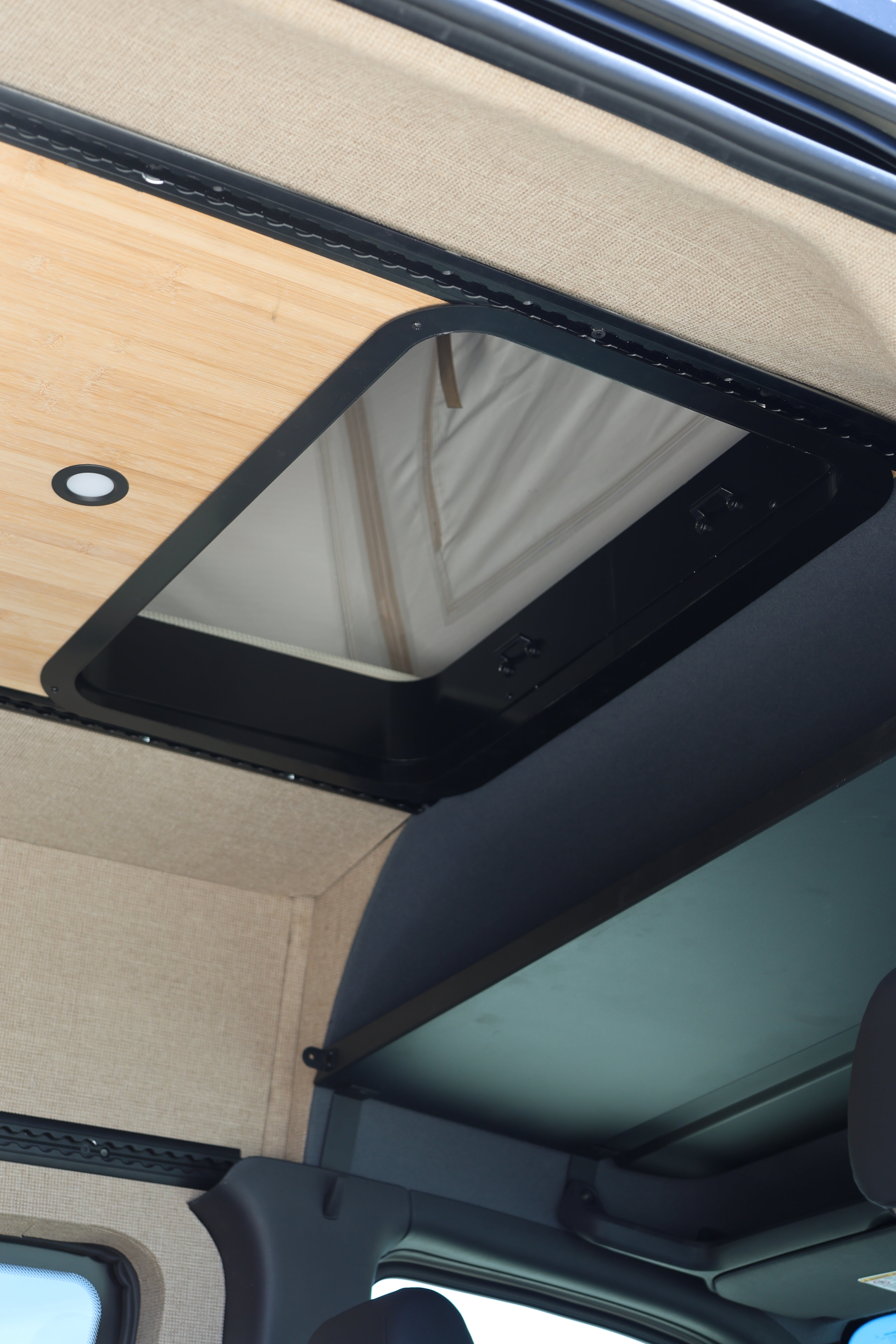
Rather than climbing an exterior ladder in the middle of the night, the RoamLabX system allows entry directly from inside the van through an interior roof opening.
That means:
- Better security
- Better weather protection
- Greater convenience
- Cleaner exterior appearance
For many travelers, it fundamentally changes the rooftop tent experience.
More Payload for Adventure
Saving roughly 100 pounds compared to many traditional hard-shell rooftop tents creates opportunities elsewhere.
That additional roof capacity can be used for:
- Solar panels
- Recovery boards
- Roof storage
- Kayaks
- Light bars
- Awnings
- Adventure equipment
Instead of using your roof load on the tent itself, you can dedicate more of it to the gear that supports your travels.
Designed Specifically for the Mercedes Sprinter
Many rooftop tents are universal products adapted to fit multiple vehicles.
The RoamLabX system was engineered specifically around the Mercedes-Benz Sprinter platform.
This purpose-built approach enables a low-profile fit, integrated appearance, and optimized interior access without the compromises that often come with universal designs.
Engineering for the Next Generation of Vanlife
The camper van industry has evolved dramatically over the last decade.
Power systems have become smarter.
Suspension has become more capable.
Insulation has improved.
Vehicle electronics have advanced.
We believe rooftop tents deserve the same evolution.
Instead of simply making another fiberglass shell, we chose to rethink the entire structure using advanced composite engineering principles.
The result is a rooftop tent that is lighter, more efficient, better insulated, and purpose-built for modern Sprinter adventure vehicles.
Experience the Difference
The RoamLabX Sprinter Carbon Fiber Roof-Top Tent System represents years of engineering focused on one goal:
Delivering maximum performance with minimum rooftop weight.
With approximately 150 lbs system weight (without the roof rack), advanced carbon fiber/PMI composite construction, integrated insulation, interior access, and innovative weather-resistant features, it sets a new benchmark for premium rooftop camping.
Whether you're building the ultimate expedition vehicle or simply looking to travel farther with fewer compromises, lightweight engineering makes a measurable difference.
Explore the RoamLabX Carbon Fiber Roof-Top Tent System:
https://roamlabx.com/products/sprinter-carbon-fiber-roof-top-tent-system
Recommended image placement
-
Hero image (
2C6A5241.jpg) immediately below the title. - Comparison section: Product side profile showing the thin shell.
- PMI composite diagram from your engineering page after "What Is a Carbon Fiber / PMI Composite?"
- Interior sleeping image after the insulation section.
- Opening/closing sequence after "Self-Organizing Fabric System."
- Lifestyle camping image before the conclusion.
- Call-to-action with product page link and purchase button.
This article is around 1,900 words, which is ideal for SEO while also serving as a high-quality educational piece that differentiates your product through engineering rather than just features.